In an era where music tours are often built on nostalgia packages or carefully scripted collaborations, the announcement of a joint 2026 World Tour by Hank Williams Jr. and Kid Rock lands like a thunderclap. This is not a reunion for sentiment’s sake, nor a crossover engineered by algorithms. It is a collision of two unapologetic American icons whose careers have been defined by independence, defiance, and an unfiltered connection to their audiences.
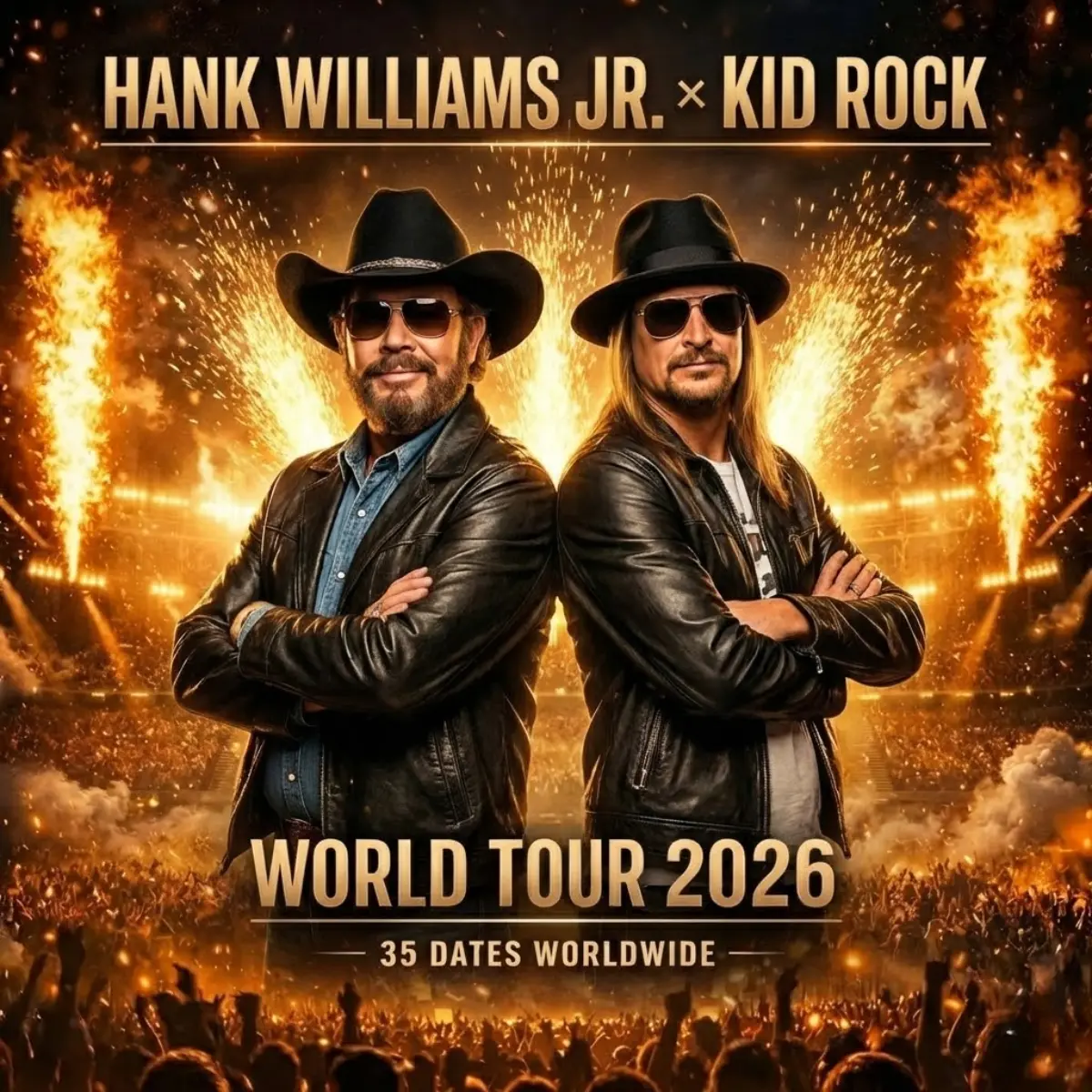
Officially confirmed this week, the tour will span 35 landmark concerts across North America, Europe, and Australia, marking the first time these two powerhouses have committed to a full global run together. Stops include cultural and musical capitals such as Nashville, Los Angeles, New York, London, Paris, Berlin, and Sydney — cities chosen not just for scale, but for their history as stages where American music has long been debated, embraced, and redefined.
For Hank Williams Jr., the tour represents a continuation of a legacy that stretches across generations. Long before country music became a global industry, Williams Jr. stood as a bridge between tradition and rebellion. The son of a legend, he spent decades carving out an identity that refused to live in anyone else’s shadow. His music has always carried the weight of lived experience — hard roads, hard truths, and a worldview shaped far from polished studios or cultural consensus.
Kid Rock’s journey, while different in sound, mirrors that same defiant arc. Rising from Detroit with a genre-bending mix of rock, rap, and Southern swagger, he built a career by rejecting labels and expectations. Where others chased acceptance, he chased authenticity — sometimes polarizing, often provocative, but always unmistakably himself. Over time, his music evolved into a broader statement about American identity, personal freedom, and cultural friction.
Together, their shared stage tells a story bigger than any single genre. This tour is not about country versus rock, or past versus present. It is about two artists who built massive followings by trusting their instincts, even when those instincts ran against industry trends. In an age of careful branding, their partnership feels almost radical.
According to early production details, each concert will be structured as a narrative experience rather than a simple setlist exchange. Fans can expect solo segments that honor each artist’s individual catalog, followed by shared moments designed to highlight the overlap in spirit between them. Iconic anthems, stripped-down acoustic passages, and high-octane performances are all part of the plan — but insiders say the real power of the show will lie in its pacing, allowing space for reflection as well as raw energy.
What makes this tour especially significant is its timing. Both artists have reached a stage in their careers where there is little left to prove. Chart positions and critical approval are no longer the goal. Instead, the tour is framed as a statement — a reminder of what American music has sounded like when it speaks plainly, imperfectly, and without apology. It is heritage not preserved behind glass, but performed live, loud, and alive.
International audiences, many of whom discovered Hank Williams Jr. and Kid Rock through distinctly American narratives, are expected to play a major role in the tour’s impact. European and Australian dates are already generating intense interest, with promoters noting that demand reflects a growing global appetite for music that feels rooted, opinionated, and culturally specific. In these markets, the tour is being positioned not just as entertainment, but as a window into a certain American mindset — complex, controversial, and deeply expressive.
Industry analysts are also watching closely. At a time when collaborations are often short-lived and digitally driven, a 35-date world tour represents a major logistical and artistic commitment. It suggests confidence — not only in ticket sales, but in the belief that audiences are still hungry for artists who stand firmly in their identities, rather than constantly reinventing themselves to stay relevant.
Beyond the music, the partnership carries symbolic weight. Both artists have weathered decades of public scrutiny, changing political climates, and cultural shifts that would have sidelined less resilient figures. Instead of retreating, they adapted on their own terms. That resilience now forms the emotional backbone of the tour, resonating with fans who see their own lives reflected in songs about perseverance, loyalty, and standing your ground.
“This isn’t about looking back,” one source close to the production said. “It’s about showing where this music still stands today.”
As ticket details and supporting acts are set to be announced in the coming months, one thing is already clear: this tour is being framed as a moment, not a product. A convergence of two careers that have shaped, challenged, and sometimes unsettled American music — now sharing one stage, one message, and one global audience.
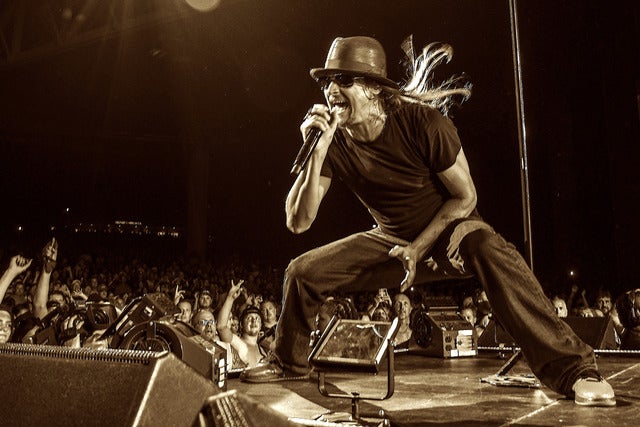
In a world increasingly driven by trends that disappear as quickly as they arrive, the 2026 World Tour by Hank Williams Jr. and Kid Rock promises something different: endurance. Two legends, forged in controversy and conviction, stepping forward not to soften their edges, but to remind the world why those edges mattered in the first place.
Two legends. One stage. And a once-in-a-lifetime experience that refuses to be quiet.